
DRINKS For
DRINKS For
DRINKS For
DRINKS For
DRINKS For

Most retailers can’t sell alcohol without licenses. Here’s how eCommerce brands add wine and spirits legally through embedded alcohol commerce.
.jpeg)
An eCommerce retailer can sell alcohol online in the U.S. without holding its own liquor license by using embedded alcohol commerce. Embedded alcohol commerce is a model in which a retailer lists wine or spirits in its own store and checkout, while licensed sellers accept, fulfill and carry the compliance for each order.
Shoppers are ready for it. In a January 2026 DRINKS survey of 550 U.S. adults, 65% said they would buy alcohol from their favorite online retailers. Among 35 to 44 year olds, the figure was 75%.
Key takeaways
• Only licensed businesses can sell alcohol in the U.S., but a retailer does not have to be the licensed seller to offer it.
• Embedded alcohol commerce keeps wine in the retailer’s own checkout while licensed partners handle the sale.
• Retailers using this model report higher order values. UrbanStems orders with wine average $189.30, against $121.81 without.
• Launch can take as little as four months.
In this guide
1. Why can’t most online retailers sell alcohol?
2. What are the ways to sell alcohol online?
3. How does embedded alcohol commerce work?
4. What results do retailers see?
5. How long does it take to launch?
6. What should you ask an alcohol commerce partner?
7. FAQ
Most online retailers can’t sell alcohol because U.S. law lets only licensed businesses make an alcohol sale, and each state sets its own rules. A retailer shipping nationally would need licenses in many states, plus systems for alcohol tax, age checks and shipping limits. Most brands decide the cost is too high.
The rules come from the three-tier system set up after Prohibition. Producers sell to distributors, distributors sell to retailers, and retailers sell to consumers, each under its own license. States add their own layer on top: excise taxes, volume caps, dry counties and carrier rules.
The result is a large category with a small online share. U.S. beverage alcohol is worth about $285 billion a year. Yet IWSR data put online sales at 3.2% of total U.S. alcohol value in 2022, with a forecast of 3.9% by 2027. Wine made up 45% of that online value.
Shoppers want to buy. In the DRINKS survey, 70% of 21 to 34 year olds said they had found alcohol online that they wanted but couldn’t easily buy. DRINKS puts this discovery-to-purchase gap at $40 billion.
There are five main ways for a retailer to offer alcohol online: get licensed, use affiliate links, list on a marketplace, launch a white-label store or use embedded alcohol commerce. They differ in cost, legal risk and whether the shopper stays in your checkout. Only embedded commerce keeps the sale in your cart without a license.
Getting licensed yourself means forming licensed entities, holding inventory and building compliant fulfillment. It is costly, slow and limited to states where you hold licenses. Affiliate links send shoppers to a wine retailer for a commission, so the customer leaves your site and you capture little revenue. A marketplace listing puts your products on a third-party site that owns the customer. A white-label store runs a branded shop, often on a separate domain, which splits the checkout and the customer data. Embedded alcohol commerce puts alcohol in your own catalog and checkout, with licensed partners selling and shipping each order.
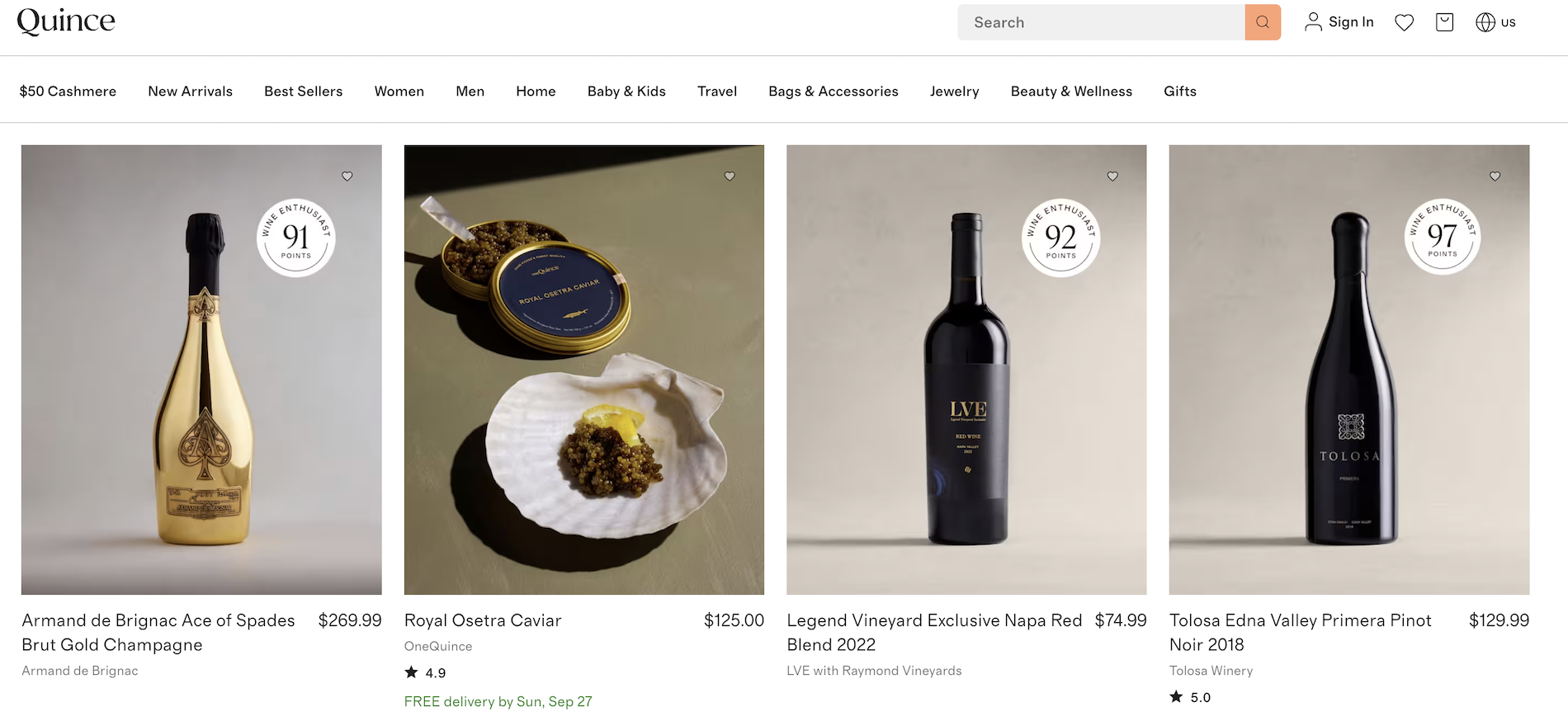
Getting licensed gives full control but costs the most. For Quince, the premium lifestyle brand, it would have meant separate legal entities by state, a compliance team, distributor relationships and inventory risk. Quince launched wine through DRINKS Anywhere instead.
Affiliate links and marketplaces send the shopper away. A white-label store keeps your brand but usually splits the checkout. Each extra step loses buyers at the moment of purchase. Half of consumers in the DRINKS survey said shopping for alcohol separately is inconvenient.
Embedded alcohol commerce connects a retailer’s catalog and checkout to a network of licensed sellers. The retailer picks and markets the wines. When a shopper checks out, software checks the address, verifies age and calculates tax, then routes the order to a licensed partner who ships it.
A typical order runs like this:
1. A shopper adds wine to the cart next to your own products.
2. The platform checks the delivery address against state and local rules, including dry areas and volume limits.
3. Age is verified at checkout.
4. Tax is calculated for the delivery location.
5. The order routes to a licensed retailer or producer that can legally ship to that state.
6. The partner ships the wine, with an adult signature (21+) required at delivery.
The retailer controls curation, merchandising, brand voice and the customer relationship. The licensed network handles licenses, inventory, tax, age checks and fulfillment. Misfits Market also used the DRINKS Anywhere wine team for sourcing. The team sampled more than 130 wines against a charter built around the grocer’s sustainability mission.
Retailers that add alcohol through embedded commerce typically see higher order values and new customers. Across partners, DRINKS Anywhere sees 2 to 5% incremental GMV from beverage alcohol, depending on promotion. Results vary by category and by how prominently wine is placed.
At UrbanStems, a floral gifting brand, orders with wine average $189.30 against $121.81 without, and 55% of wine orders come from new customers. At Half Baked Harvest, a food creator, the average order grew to $165 from about $116 at launch, at about eight bottles per order. Misfits Market, an online grocer, sold more than 100,000 bottles in year one and grew average order value 15.4% year over year.
The common thread is placement. UrbanStems put wine in its existing cart as an add-on, the same way it sells vases. Its wine attachment rate is 62% higher than comparable add-ons on the site.
A retailer can launch alcohol through embedded commerce in as little as four months. Timing depends on how deep the checkout integration goes and how large the assortment is. Launching before your busiest season gives shoppers time to find the new category.
Misfits Market launched in four months and sold more than 100,000 bottles in its first year. UrbanStems went live in November 2025, three months before Valentine’s Day, so wine was already part of the experience at its peak.
Before choosing a partner, ask who the licensed seller is, where they can ship and whether alcohol stays in your own checkout. The answers decide your legal exposure, your reach and your conversion rate. A good partner can also produce order, tax and age-check records on request.
Questions to ask:
• Who is the seller of record on each alcohol order?
• Which states can your licensed network ship to, for wine and for spirits?
• Does alcohol sit in my checkout, or does the shopper leave my site?
• How are tax, age checks and state limits applied?
• Who owns the customer data?
• Can you help source an assortment that fits my brand?
Shipping reach varies by product and seller type. As of 2026, 48 states plus D.C. allow wineries to ship wine direct to consumers, according to Free the Grapes. Far fewer allow retailers or distilleries to ship. Our guide to alcohol shipping laws by state covers the details.
Can any online store sell alcohol? Not on its own. A store without licenses can offer alcohol only through licensed partners who accept and fulfill each order. Embedded commerce makes that possible inside the store’s own checkout.
Do I have to hold inventory to sell wine online? No. In embedded commerce, licensed retailers and producers hold and ship the inventory. The retailer never buys or stores bottles.
Is it legal for an eCommerce retailer to sell wine? Yes, when licensed businesses make the sale and each order meets the rules of the delivery state. The retailer acts as the marketer and storefront.
How much revenue can alcohol add? DRINKS partners typically see 2 to 5% incremental GMV from adding beverage alcohol, depending on promotion.
Which type of alcohol is easiest to sell online? Wine. It can ship to the most states and made up 45% of U.S. online alcohol value in IWSR’s data.
About DRINKS Anywhere. DRINKS Anywhere lets eCommerce retailers and consumer brands sell wine and spirits in their own checkout, without licenses, inventory or fulfillment. Licensed partners sell and ship every order, and DRINKS handles state rules, tax and age checks. Talk to our team.
Latest articles

Blog
DRINKS Anywhere
eCommerce
Wine

Blog
DRINKS Anywhere
eCommerce
Wine
Blog
DRINKS Anywhere
eCommerce
Wine