
DRINKS For
DRINKS For
DRINKS For
DRINKS For
DRINKS For

Over 65% of consumers want to buy alcohol from their favorite online retailers. In the 35-44 prime spending demographic, that number hits 75%. Yet most e-commerce brands have never offered it.
That gap between consumer demand and category availability came up repeatedly during our recent webinar on category expansion and RFM optimization. The argument is straightforward: if you want to increase basket sizes, shopping frequency, and customer lifetime value, high-affinity complementary products are the fastest lever you can pull. Here's what we covered.
The 95-5 rule is a useful heuristic. At any given time, roughly 95% of your potential customers aren't in the market for your core product. In some categories, that figure runs closer to 98%.
Most people buy infrequently. They buy in the moment. And the more moments you create — more reasons to visit your site, more reasons to add something to the cart — the more you sell.
This is the central challenge for single-category e-commerce brands. A customer visits to buy a hoodie, a bouquet, an airline ticket. They complete that purchase. Then there's no reason to come back until they need that specific thing again.
Adding high-affinity categories changes the equation. It builds mental and digital availability. It gives consumers another reason to be on your site, another reason to engage, another reason to come back sooner.
E-commerce teams get buried in conversion rates, bounce rates, and a thousand other metrics. But the metric that shifts everything is recency: when did this customer last shop with you?
For many brands, customers visit once, twice, maybe three times a year. Adding just one or two additional shopping trips per customer transforms the economics of your business.
Recency drives frequency. Frequency drives basket growth. Basket growth drives lifetime value. And complementary categories are the single greatest revenue and retention lever to shift that cycle.
McKinsey's research backs this up. Cross-selling and category expansion drive revenue increases of 20-30%. This isn't theory. It's what happens when you give customers more reasons to buy from the place they already trust.
People worry that adding an out-of-category product creates too much cognitive load. A customer came to buy flowers — now you want them to buy wine too?
Yes. And they will.
The majority of purchase decisions are emotional, made in the moment. Consumers move from one product to the next when the pairing feels natural. Wine with flowers for a gift. Wine with gourmet food for a Friday dinner. Wine with glassware for an evening at home.
There's a psychological principle at work here. Adding an in-category product to an existing basket gets harder the more items you add. But an out-of-category, high-affinity product actually reinforces the basket. It makes the overall purchase feel more complete.
Among women shopping online, alcohol is one of the highest-affinity complementary categories. For men shopping on-site, same story. For gift purchasing, the affinity is even stronger.
Yet buying alcohol online has historically been harder than buying a t-shirt. Regulatory complexity, licensing requirements, inventory risk, and compliance headaches locked most e-commerce brands out of the category entirely.
That's no longer the case. Platforms like DRINKS Anywhere let brands offer curated alcohol selections without holding licenses, carrying inventory, hiring compliance staff, or disrupting their existing checkout experience. The wine integrates natively into the cart. The customer never leaves your site.
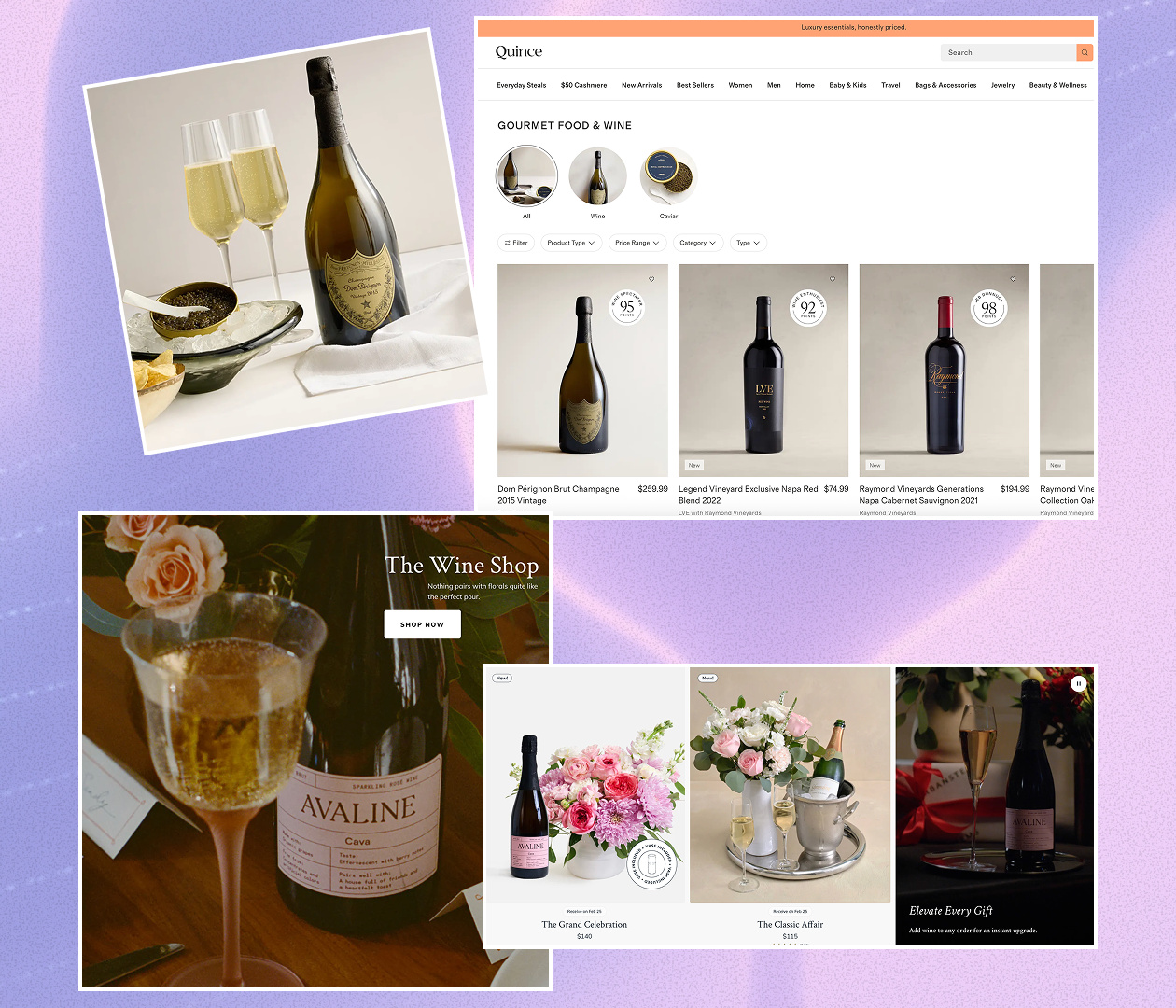
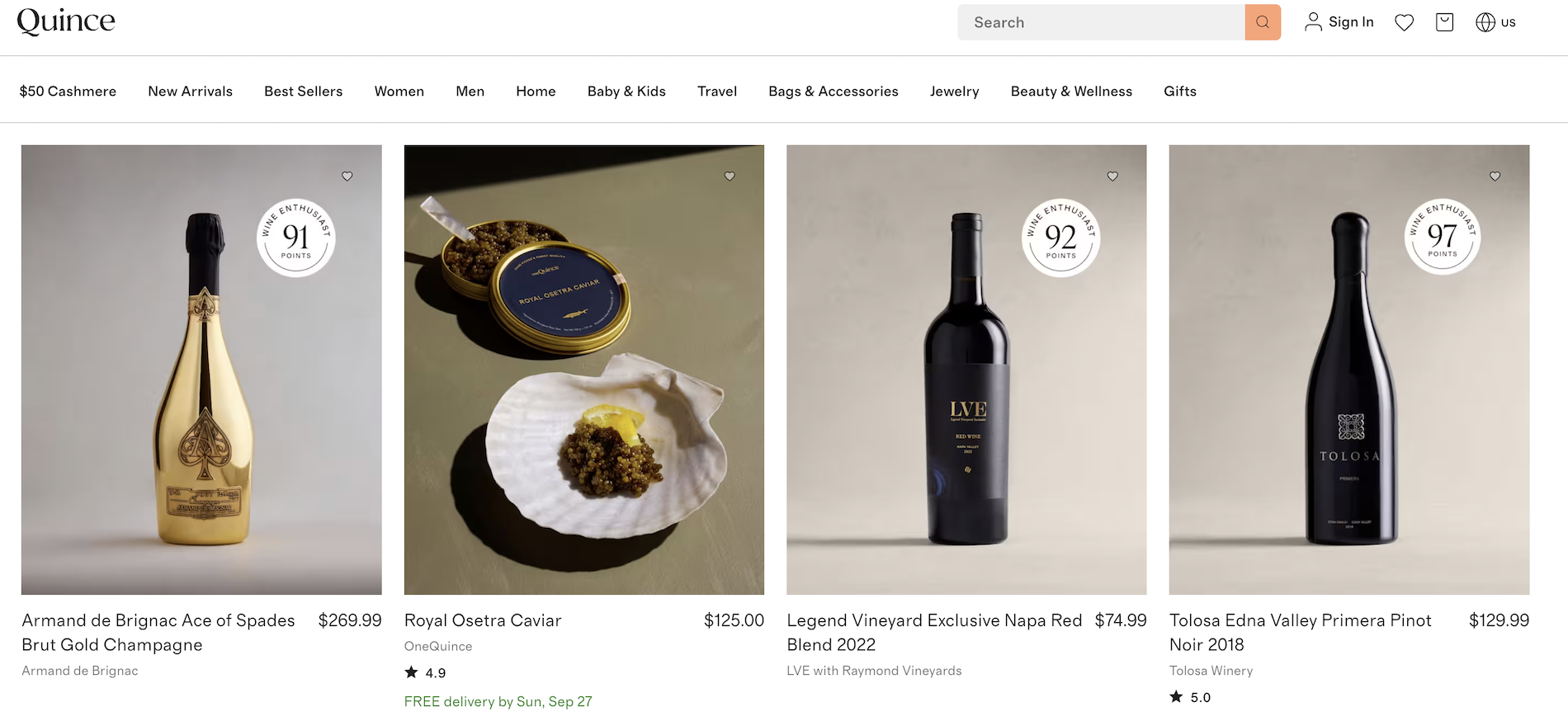
Quince — one of the fastest-growing e-commerce brands in the U.S. — had already proven the high-affinity concept with gourmet food. They sell a surprising amount of caviar.
When they added wine through DRINKS Anywhere, they started with Dom Pérignon. That seems counterintuitive. Most brands test with value wines first. But Quince's customers expect premium quality. Starting with a recognized luxury brand established credibility and signaled that wine curation met the same standard as their cashmere and organic bedding.
The results confirmed the strategy. Sales grew quickly, and the brand now targets specific occasions — Valentine's Day, holidays, gifting moments — that their core apparel category couldn't capture alone. Wine gave them new reasons for customers to visit, new moments to sell into, and higher basket values with zero operational complexity.
UrbanStems approached it differently. Wine and flowers are a natural pairing, but instead of just adding bottles to the site, they focused on curated pairings: red wine with red bouquets, champagne with celebration arrangements, rosé with spring flowers.
That attention to pairing reduced cognitive load. Customers didn't have to think about what wine to choose. The recommendation felt obvious and elevated the gifting experience.
Wine became one of UrbanStems' highest attach-rate categories — roughly 62% higher than adding chocolates, cookies, or other add-ons. Customers spending $60-70 on flowers are more than willing to add two bottles of $40 wine because it makes the gift better together.
The category also spikes volume during key gifting moments like Valentine's Day and Mother's Day, creating seasonal revenue that flowers alone couldn't fully capture.
AI search and discovery bars on e-commerce sites are changing how customers find complementary products. A shopper asks "what goes well with this?" and the site surfaces a curated wine pairing alongside the product they're already considering.
This is happening now. Singapore Airlines reduced a 20-click ticket purchase to roughly three interactions using AI chat. The same principle applies to product discovery. When AI surfaces high-affinity products at the right moment, conversion rates climb.
The brands getting this right are surfacing wine alongside related products — glassware, serving trays, recipe ingredients — creating a discovery experience that feels helpful rather than promotional.
Quince, UrbanStems, Misfits Market, Instacart, Macy's, Half Baked Harvest — they all added alcohol as a high-affinity category. They all maintain full control over curation, brand experience, merchandising, and customer data. And they all did it with zero operational lift.
No licenses needed. No inventory to hold. No compliance team to hire. The category plugs into the existing checkout experience. DRINKS only makes money when the brand sells product, so the incentive structure is fully aligned.
The curation process is collaborative. DRINKS' AI engine analyzes brand positioning, customer demographics, and basket data to recommend an initial assortment. The brand makes the final call on what appears on their site. Some start small and expand. Others launch with a full wine page from day one.
Adding high-affinity categories isn't about turning your site into a marketplace. It's about surfacing two or three complementary product categories that feel native to your brand, drive customers back more often, and increase what they spend when they're there.
The best single-category e-commerce sites will add at least two to four new high-affinity categories over the coming year. They'll use their existing infrastructure to do it. And they'll see measurable shifts in recency, frequency, and basket size within weeks.
Social commerce makes this even more powerful. Alcohol content on social platforms drives traffic to sites where customers can actually purchase. That's another entry point, another discovery channel, another reason for someone to land on your site and start shopping.
This recap covers the highlights. The complete webinar includes:
Access the full webinar recording and get:
The recording walks through exactly how to implement this strategy. Watch the session, assess where your brand sits today, and start building your category expansion plan this quarter.
Latest articles
.jpeg)
Blog
DRINKS Anywhere
eCommerce
Wine
Blog
DRINKS Anywhere
eCommerce
Wine
Blog
DRINKS Anywhere
eCommerce
Wine