
DRINKS For
DRINKS For
DRINKS For
DRINKS For
DRINKS For


You need a liquor license to sell alcohol online only if your business is the seller of record. The seller of record is the licensed business that legally makes the sale, collects the tax and answers to regulators. A retailer without a license can still offer wine on its website when a licensed partner is the seller of record on every order.
That difference matters. Shopify’s own alcohol guidance tells merchants selling alcohol directly to “acquire and maintain all necessary licenses individually to produce, market, sell, and deliver your products.” Embedded alcohol commerce moves that duty to a licensed partner.
Key takeaways
- The seller of record needs the licenses. The business that markets the product does not.
- Retailers without licenses offer wine through licensed partners who accept, ship and report each order.
- The licensed seller carries compliance for the sale. The retailer stays responsible for how it markets alcohol.
- Getting licensed yourself limits you to about a dozen states that allow retailer shipping.
In this guide
1. Who needs a liquor license to sell alcohol online?
2. Can a retailer without a liquor license sell wine online?
3. Who is responsible for compliance?
4. What does a compliant order look like?
5. What does getting licensed yourself involve?
6. Is selling alcohol without a license a loophole?
7. FAQ
Any business that takes ownership of alcohol and sells it to consumers needs a license in its home state. To ship across state lines, it also needs a permit from each state it ships to. Wineries, distilleries and licensed retailers hold these. A business that only markets alcohol while a licensed partner makes the sale does not.
The licenses that matter for online sales fall into two groups:
• A home-state license to sell alcohol to consumers, such as an off-premise retail license or a winery license.
• Direct shipping permits from each destination state, where that state allows it.
Those permits are much easier to get for wineries than for retailers. As of 2026, 48 states plus D.C. allow wineries to ship wine to consumers, according to Free the Grapes. Only about 12 states plus D.C. allow out-of-state retailers to ship wine, per Avalara.
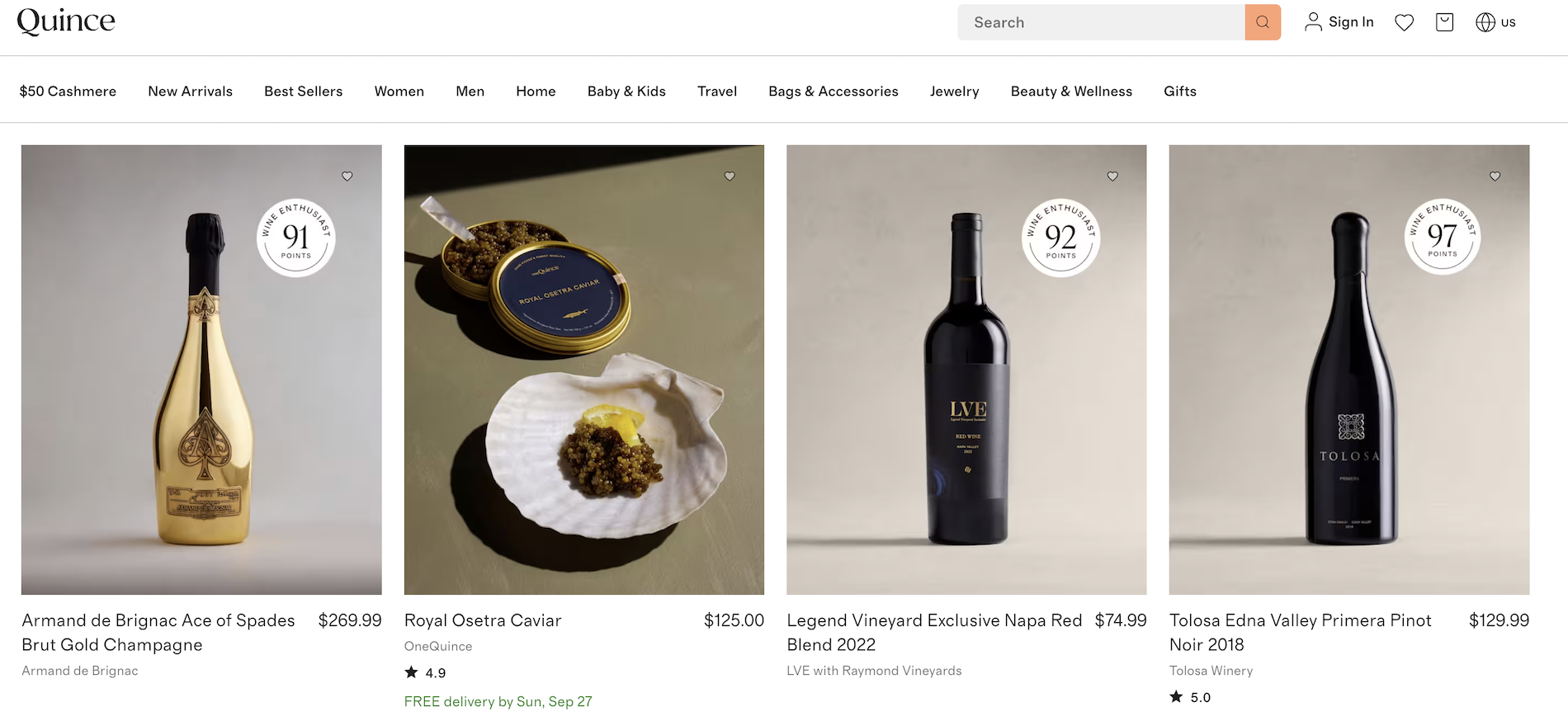
Yes. A retailer without a license can offer wine on its site while a licensed retailer or producer is the seller of record. The unlicensed retailer curates and markets the wine. The licensed partner accepts the order, collects the tax, ships the bottle and keeps the records. UrbanStems, Quince and Misfits Market all sell wine this way.
Quince, the premium lifestyle brand, launched wine in December 2025 through DRINKS Anywhere. Wine appears next to caviar, serving pieces and gourmet pantry items, and it checks out in the same cart as everything else. Quince holds no alcohol license and no wine inventory.
“Our customers love discovering elevated essentials at Quince and the wine category presented a seemingly unexpected extension of how they already shop with us,” said Daphne de Chatellus, Head of Emerging Categories at Quince.
The licensed seller of record is responsible for compliance on each alcohol sale. That covers tax, age checks, state volume limits and shipping rules. In embedded commerce, the platform applies those rules at checkout and routes each order to a partner licensed for that state. The retailer stays responsible for how it markets alcohol.
In practice, the retailer owns curation, product pages and marketing, and must market alcohol only to adults 21 and over. The licensed partner and platform own everything regulated: age verification at checkout and delivery, excise and sales tax, state shipping rules and volume limits, licenses and permits, fulfillment and records. The platform can also help with sourcing and sets the rules for how alcohol appears on the retailer’s site.
Retailers should still check their partner’s work. Ask to see how age is verified, how tax is filed and what records exist for each order.
A compliant online alcohol order passes five checks before it ships: address, product, age, tax and seller. If any check fails, the order stops before payment. The shopper sees one checkout. The checks run behind it.
1. Address. Is delivery allowed in that state, county and town? Is the shopper under the state’s volume limit?
2. Product. Is this wine approved to ship into that state?
3. Age. Is the buyer 21 or older? An adult signature is also required at delivery.
4. Tax. What excise and sales tax apply at that address?
5. Seller. Which licensed partner can legally ship this order to this state?
State rules change often, so these checks need to run in real time. DRINKS applies regulatory rules across all 50 states at checkout. Our guide to alcohol shipping laws by state explains how the rules differ.
Getting licensed yourself means forming a licensed entity, holding inventory, securing a permit for each state you ship to and filing alcohol tax returns, often monthly. It gives full control. It also limits a retailer to the roughly 12 states plus D.C. that allow out-of-state retailer shipping.
The work usually includes:
• A separate legal entity, since many states license the business, not the brand
• A compliance team to track rules in every state you serve
• Distributor or supplier relationships, where large accounts get priority
• Capital tied up in wine inventory
• Fulfillment that meets carrier rules for alcohol
For Quince, that path would have meant all of the above. Embedded commerce let it add wine without any of it.
No. Every sale still goes through a licensed business under state law, and the three-tier system stays intact. The retailer plays the role a publisher or marketplace plays in other categories: it brings the customer. The licensed partner makes the sale.
Many shoppers don’t know this model exists. In a January 2026 DRINKS survey, 1 in 5 Americans didn’t know buying alcohol online was possible, and 24% said it is harder than it should be. Clear, legal options inside stores people already trust help close that gap.
Do I need a liquor license to sell wine on my website? Only if you are the seller of record. If a licensed partner makes and ships each sale, you do not need your own license.
Who is the seller of record in embedded commerce? The licensed retailer or producer that accepts and fulfills the order.
Can an influencer or content creator sell wine without a license? Yes, through the same model. Half Baked Harvest sells wine to its 5 million-plus community with a licensed partner handling every order.
Do I need a license to sell non-alcoholic wine? Generally no, since most non-alcoholic wine falls outside alcohol laws. Check state rules for products near the 0.5% ABV line.
What happens during an audit? Records sit with the licensed seller and the platform. Your partner should be able to produce order, tax and age-check records on request.
About DRINKS Anywhere. DRINKS Anywhere lets eCommerce retailers and consumer brands sell wine and spirits in their own checkout, without licenses, inventory or fulfillment. Licensed partners sell and ship every order, and DRINKS handles state rules, tax and age checks. Talk to our team: https://drinks.com/contact
Latest articles
.jpeg)
Blog
DRINKS Anywhere
eCommerce
Wine
Blog
DRINKS Anywhere
eCommerce
Wine
Blog
DRINKS Anywhere
eCommerce
Wine